
When I open the door to an electrical panel during a home inspection in Gaylord, Petoskey, or Charlevoix, I’m looking at one of the most consequential components in the entire house. The panel is the nerve center of your home’s electrical system. It controls every circuit, protects every appliance, and, if anything goes wrong in there, it’s the first line of defense against fire.
Buyers often come to me with the same questions: Should I be worried about a Federal Pacific panel? Is a 100-amp service enough for a modern home? What electrical problems are expensive to fix — and can they affect my negotiations before closing?
These are exactly the kinds of issues I’m evaluating during an electrical panel inspection. Here’s an honest, practical breakdown of what I look for, what I find most often in Northern Michigan homes, and why it matters to you as a buyer.
At a Glance:
- An electrical panel inspection is included in every standard buyer’s home inspection
- Scott removes the dead front cover (the interior panel cover) when conditions permit — this is where the most important findings are
- Common issues in Northern Michigan homes include double-tapped breakers, undersized service, moisture-related corrosion, and incomplete grounding
- Certain older panel brands — including Federal Pacific (Stab-Lok) — warrant evaluation by a licensed electrical contractor
- Most electrical findings are negotiable before closing; some require correction before a transaction can proceed
- Scott Frakes, CMI®, has completed 2,000+ inspections across Gaylord, Petoskey, Charlevoix, Boyne City, Harbor Springs, East Jordan, and surrounding areas
What Is an Electrical Panel Inspection?
An electrical panel inspection is a thorough visual assessment of the main service panelboard — the breaker box — and the electrical service components connected to it.
As part of a full residential home inspection, I evaluate the panel in accordance with the InterNACHI® Standards of Practice, which define what a qualified inspector is required to examine.
That includes:
- The service-entrance conductors (the wires bringing power into your home)
- The main service disconnect (the master shutoff)
- The panelboard itself — breakers, bus bars, wiring, and enclosure
- Overcurrent protection devices (breakers and fuses)
- Service grounding and bonding
I also remove the dead front cover — the interior panel cover — when it’s safe to do so. This is where the real inspection happens. A lot of inspectors stop short of this step. I don’t.
Before I Even Open the Panel: What I’m Watching For
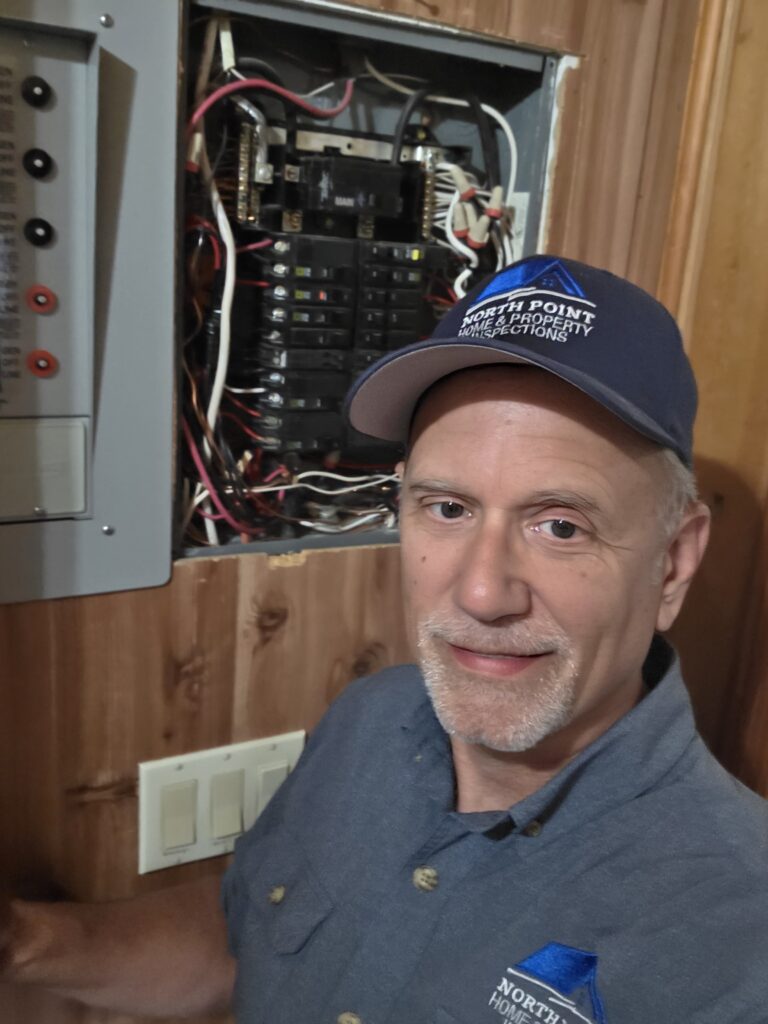
A thorough electrical inspection starts before I touch the panel. I’m looking at the meter, the service mast or lateral, and the exterior of the enclosure itself.
Is the panel mounted correctly? Is there adequate working clearance (at least 36 inches) in front of it? Is it in an approved location? (Panels are not permitted in bathrooms, closets, or over stairways.) Are there visible signs of corrosion, rust, or moisture damage?
In Northern Michigan, moisture is one of the more common contributors to panel problems — even when the panel itself is inside. Basement panels in older Gaylord-area homes are sometimes exposed to seasonal humidity, sump pump failures, or minor water intrusion that causes corrosion inside the enclosure over time. Panels in unheated attached garages are subject to significant temperature swings and condensation. And where the service conductors enter the home through the foundation or exterior wall, I’m checking for signs of water intrusion near that penetration — especially in homes with a history of ice damming or poor flashing at the roofline.
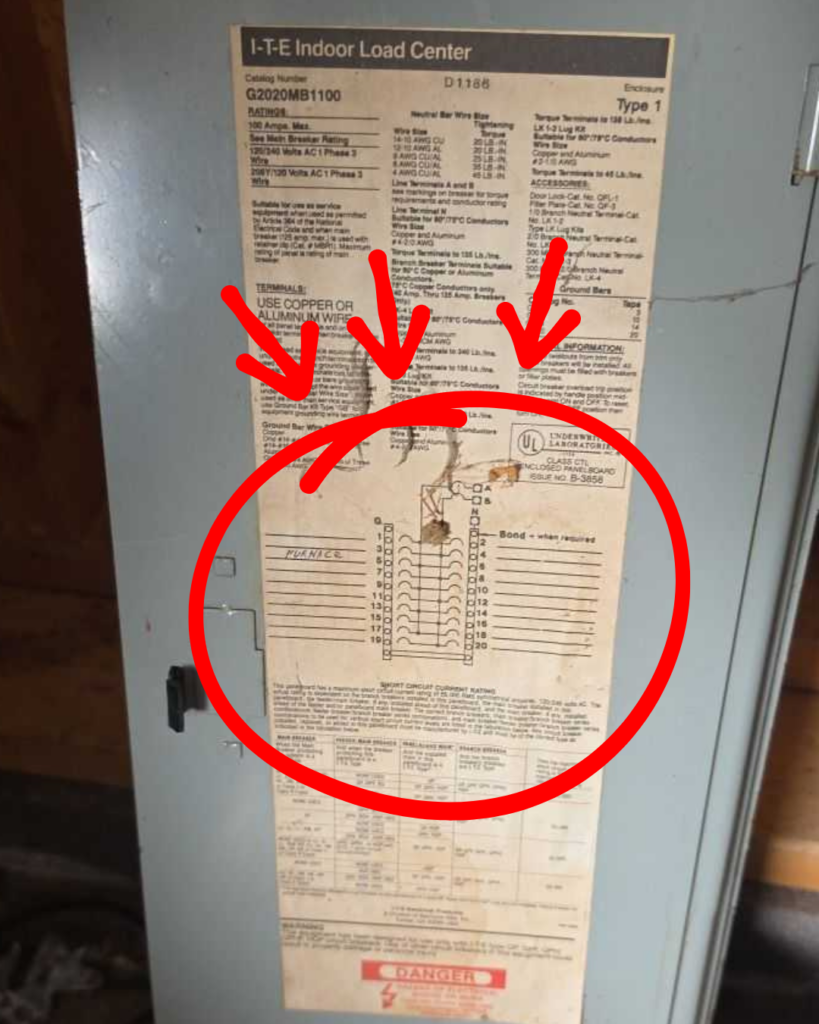
I also check the legend — the circuit directory. An unlabeled or poorly labeled panel is more than a nuisance. In an emergency, not knowing which breaker controls which circuit is a genuine safety risk. In my experience across 2,000+ inspections in the Gaylord area and throughout Northern Michigan, incomplete or inaccurate legends are among the most common issues I document in an electrical panel inspection.
Inside the Panel: What I’m Looking At
Once the dead front cover is safely removed, I do a systematic visual inspection of everything inside. Here’s what I evaluate inside every panel, and what I’m looking for during the electrical panel inspection.
Service Size and Conductor Sizing
I determine the service amperage — typically 100-amp or 200-amp in Northern Michigan homes — by looking at the main breaker rating, the service-entrance conductors, and the panel’s listed capacity. All three should agree. When they don’t, it’s a flag that work was done without permits, or that equipment was swapped out without proper sizing.
A 200-amp service has become the standard expectation for modern homes. Many older homes in Traverse City, Charlevoix, and surrounding areas were originally built with 100-amp or even 60-amp service. That may have been fine in 1975. It often isn’t sufficient for today’s loads — especially as more homes add EV chargers, heat pumps, or updated kitchens.
Breakers and Overcurrent Protection
Every breaker is there for a reason: to protect the wiring in that circuit. A breaker that’s too large for its wire is a fire hazard. I’m visually checking wire gauge against breaker size throughout the panel.
I’m also checking for:
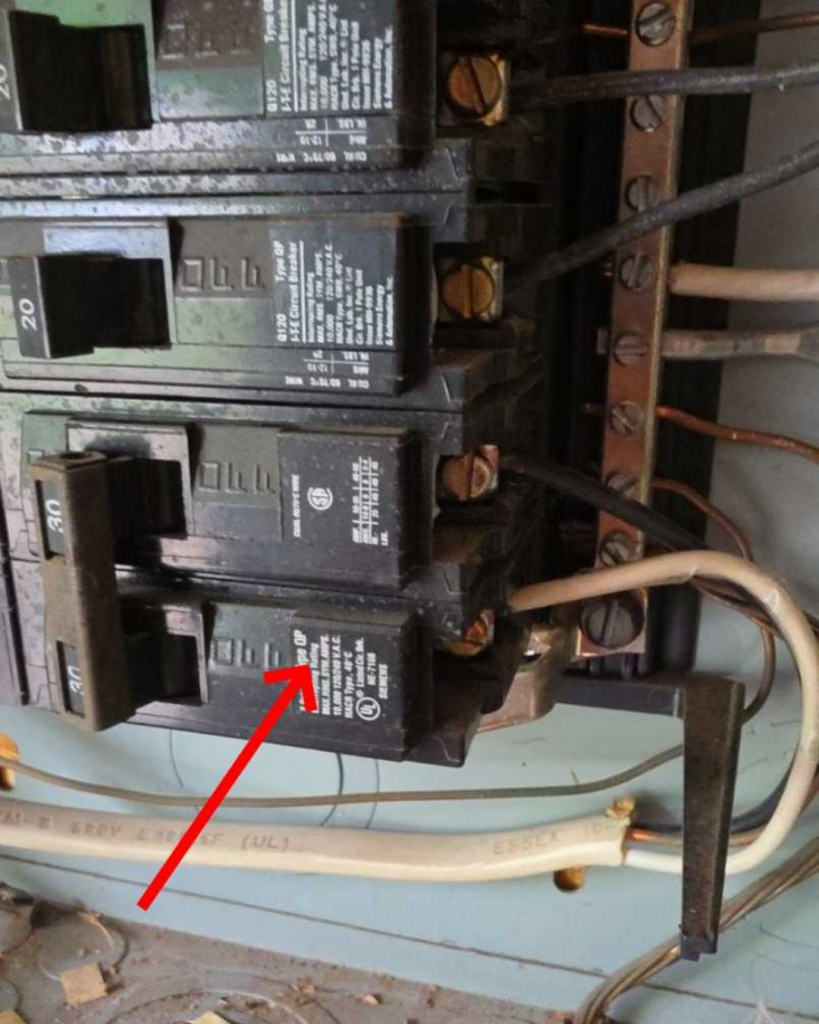
Double-tapped breakers. A double-tap is when two wires are connected to a single breaker that’s only listed for one. It’s one of the most common defects I find. In most cases, it’s not an immediate emergency, but it’s a code violation and a condition that should be corrected.
Damaged or broken breakers. A cracked or physically damaged breaker has taken some kind of trauma. I note it and recommend evaluation by a licensed electrician.
Breakers that don’t match the panel manufacturer. Not every off-brand breaker in a panel is a defect — some “classified” breakers are UL-listed for use in specific panels. But breakers that aren’t listed for their enclosure need to be flagged.
Missing knockouts. Open holes in the enclosure allow pests, moisture, and — in worst-case scenarios — human contact with energized components.
Wiring Concerns
The wiring inside the panel tells a story. I look at conductor sizing, the condition of insulation, how wires are routed, and whether everything is terminated properly.
A few things I pay particular attention to during an electrical panel inspection:
Aluminum wiring. Aluminum conductors were commonly used in homes built in the late 1960s and 1970s. The wiring itself isn’t necessarily dangerous, but aluminum connections at terminals and devices require specific attention. Loose or oxidized aluminum connections at breakers are a legitimate fire risk.
Improper wire identification. White conductors used as “hot” wires in 240-volt circuits need to be re-identified with black tape. Green conductors should only be used for equipment grounds. When these conventions aren’t followed, it creates confusion — and risk — for anyone working on the system later.
Melted or scorched insulation. This is a serious finding. Melted insulation indicates that a conductor has been running hot — a sign of overload, a poor connection, or both. When I see it, I recommend immediate evaluation.
Grounding and Bonding
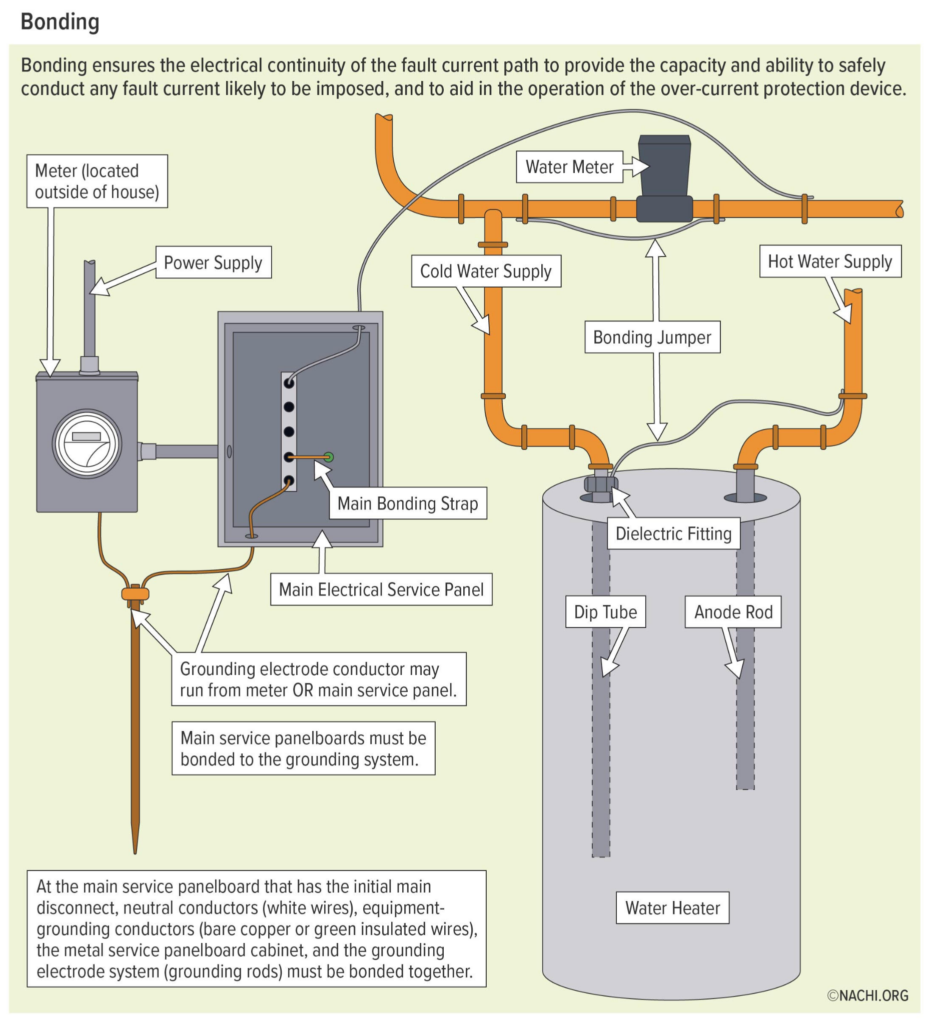
Grounding and bonding are two distinct but related concepts that often get conflated. The short version: bonding ties metal parts together to create a clear path for fault current, to ensure that a breaker trips when something goes wrong. Grounding (via the grounding electrode system) addresses lightning and surges.
Both need to be present and properly installed. I look at the grounding electrode conductor (the wire that runs to your ground rods or water pipe), the main bonding jumper connecting the neutral bus to the panel enclosure, and the presence of a grounding electrode system.
In older Northern Michigan homes, I sometimes find that the supplemental grounding electrode — a second ground rod required when the water pipe is used as the primary electrode — was never installed.
Older Panels That Warrant Extra Attention
Not every old panel is an automatic red flag, but certain brands and designs have documented histories of performance issues. Federal Pacific Electric (Stab-Lok) panels and Zinsco panels are among the most discussed in the inspection industry – and I do find them occasionally in mid-20th century Northern Michigan homes. These brands have faced scrutiny over breakers that may not trip reliably under overload conditions.
I don’t tell buyers to immediately replace any panel I encounter. I’m not an electrician, and the decision about remediation belongs to a licensed electrical contractor. But when I see one of these panels during an electrical panel inspection, I document it and recommend that the buyer get a qualified evaluation.
Split-Bus Panels
Split-bus panels, common in homes built from the 1950s through the 1970s, don’t have a single main breaker. Instead, they use up to six large breakers to control the upper bus, with one of those breakers controlling the lower section. They’re not inherently unsafe, but they’re an older design that buyers should be aware of, because that often signals a panel nearing the end of its service life.
What I Actually Find: The 6 Most Common Electrical Panel Issues I Find in Northern Michigan Homes
The process walkthrough above covers what I’m looking for. Here’s what I actually find. The following are the top 6 issues that come up most often during electrical panel inspections across Gaylord, Petoskey, Charlevoix, Boyne City, Harbor Springs, and the surrounding area.
1. Incomplete or missing circuit directories.
The most common finding, by far. A blank legend isn’t a safety emergency, but it’s a genuine problem in any situation where you need to shut off power quickly.
2. Double-tapped breakers.
Extremely common, especially in homes that have had additions, outbuildings, or updated appliances added over the years. Someone needed another circuit and took a shortcut at the panel.
3. Undersized service (100-amp or less).
Northern Michigan has a significant stock of older homes — cottages, farmhouses, and year-round residences built decades before modern electrical loads were anticipated. A 100-amp service that powered a 1960s home comfortably may be a limitation for today’s buyer.
4. Moisture intrusion and corrosion.
Our climate is hard on exterior panels. Freeze-thaw cycles, condensation, and ice damming near service equipment can cause corrosion inside the enclosure over time. I see this more frequently in older homes.
5. Improper grounding or missing supplemental ground rods.
Grounding electrode systems are often incomplete, particularly in homes that predate current requirements or that have had partial electrical updates without a full system review.
6. DIY wiring work inside the panel.
Northern Michigan has a strong tradition of self-sufficiency, and that extends to home repair. I have a lot of respect for that. But inside an electrical panel is not the place to improvise. Unlabeled wires, mismatched connectors, and improperly terminated conductors tell me that someone worked in this panel without a permit or a license — and now it needs a qualified eye.
A Quick Reference: How I Think About Electrical Panel Inspection Findings
| Finding | Concern Level | Typical Next Step |
| Melted or scorched insulation | High | Licensed electrician — prompt |
| Missing panel bonding | High | Licensed electrician — prompt |
| Federal Pacific / Zinsco panel | High | Licensed electrician evaluation |
| Missing GFCI at required locations | High | Licensed electrician — prompt |
| Double-tapped breakers | Moderate | Licensed electrician correction |
| Unlisted breaker brands | Moderate | Verify classification; electrician if unclear |
| Missing knockouts | Moderate | Repair or replace enclosure |
| Aluminum wiring at devices | Moderate | Electrician evaluation |
| Incomplete grounding electrode | Moderate | Licensed electrician |
| 100-amp service in modern home | Moderate | Assess loads; upgrade may be needed |
| Blank or incomplete circuit directory | Low | Update panel labeling |
| Split-bus panel (functional) | Low–Moderate | Monitor; electrician evaluation |
| Minor wiring neatness issues | Low | Note: no urgent action required |
This isn’t a pass/fail list — it’s a framework for understanding what I find and how seriously to take it. Every situation is different, and a licensed electrical contractor is always the right resource for remediation decisions.
GFCI Protection: A Simple Safety Feature That Homes In Our Region Often Don’t Have
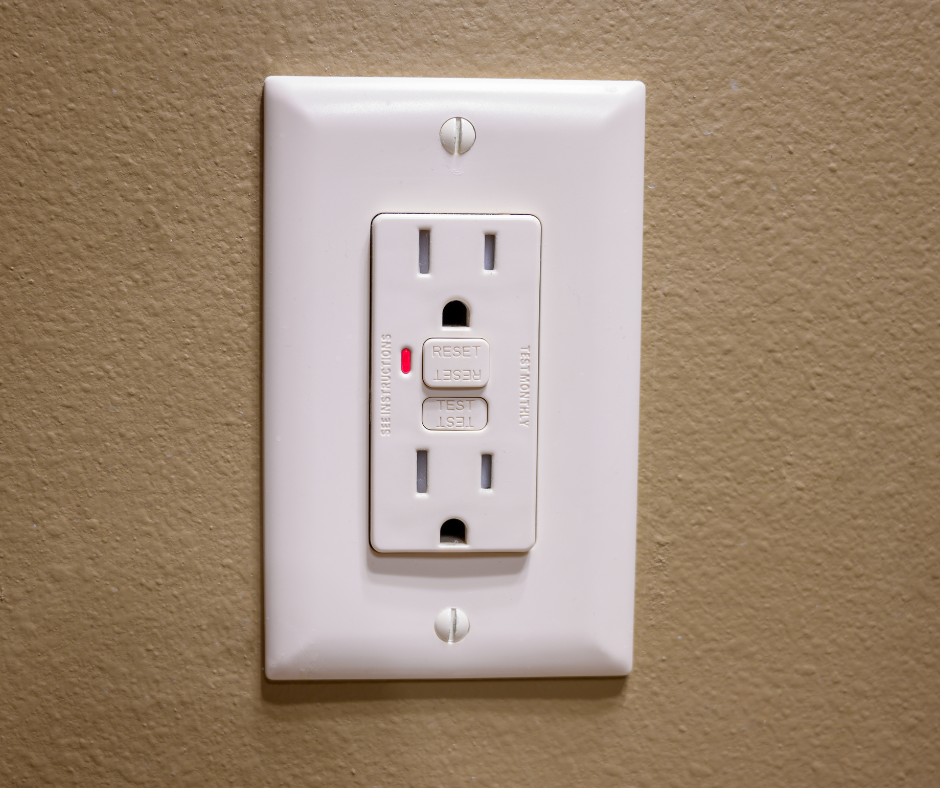
While we’re on the topic of electrical inspections, it’s worth mentioning GFCI outlets. While they’re not technically part of an electrical panel inspection, they’re an important electrical safety feature every home should have – but many in northern Michigan don’t.
Per current NEC standards, Ground Fault Circuit Interrupter (GFCI) protection is required in kitchens, bathrooms, garages, exterior outlets, crawlspaces, and anywhere receptacles are installed near water or in potentially moist locations.
A GFCI detects tiny imbalances in electrical current — the kind that happen when electricity is finding a path to ground through a person — and cuts power in a fraction of a second. It’s one of the most effective electrical safety features ever developed. It’s also one of the most commonly missing or non-functional items I find during inspections.
In older Northern Michigan homes, GFCI protection is frequently absent in locations where it’s now required — particularly in bathrooms and garages. In some cases, a GFCI receptacle was added at some point but has since failed and no longer trips correctly. I test every accessible GFCI receptacle during my inspections and document anything that doesn’t function as it should.
The good news: GFCI corrections are usually among the least expensive electrical repairs. A licensed electrician can install or replace GFCI receptacles quickly. It’s worth knowing going in, though, because missing GFCI protection at required locations is something I flag as a higher-priority finding.
What Buyers Should Know Before Closing
An electrical panel inspection isn’t about finding reasons to walk away from a home. It’s about knowing what you’re buying. Moderate-priority findings are often negotiable before closing — a credit toward electrical repairs, or a seller-funded correction. High-priority findings warrant contractor evaluation before the transaction moves forward.
I’ve done this enough times to know that buyers who understand their electrical system going in are buyers who close with confidence. Those who find out after closing wish they’d asked more questions.
Why Panel Inspections Require More Than a Glance
I’m a Certified Master Inspector® — a designation earned through a documented record of inspections, rigorous continuing education, and adherence to the industry’s most demanding Code of Ethics. I also hold 24+ specialized certifications through InterNACHI®, including advanced electrical inspection training.
I mention this not to impress you, but because electrical panel inspections are one of the areas where experience genuinely matters. Knowing which wire gauges look right for which breakers, recognizing the subtle visual signs of a loose connection, understanding what a particular panel manufacturer’s documentation says about classified breakers — this is the kind of detail that comes from doing thousands of inspections, not hundreds.
If you’re buying a home in the Gaylord, Petoskey, Charlevoix, Boyne City, Harbor Springs, East Jordan, Grayling, or Traverse City area, I’d be glad to walk you through exactly what your panel is telling us.
Frequently Asked Questions About Electrical Panel Inspections
Does a home inspection include the electrical panel?
Yes. A standard buyer’s home inspection covers the electrical panel, service-entrance components, main disconnect, overcurrent protection devices, and visible wiring — per InterNACHI® Standards of Practice.
Does the inspector remove the panel cover?
Removing the dead front cover is not strictly required by the Standards of Practice, but a qualified inspector will remove it when it’s safe to do so. I always remove it when conditions permit. The most important findings are inside.
What electrical issues fail a home inspection?
A home inspection isn’t a pass/fail process — it’s a thorough documentation of conditions. I report everything I observe, categorized by severity, and let you make an informed decision. That said, serious electrical defects like scorching, recalled panels, and missing grounding are findings that warrant contractor evaluation before you close.
Is a Federal Pacific panel dangerous?
Federal Pacific Electric (Stab-Lok) panels have a documented history of breakers that may not trip under overload conditions, which raises the risk of electrical fire. I document these panels and recommend evaluation by a licensed electrical contractor. Whether to replace the panel is ultimately a decision made by you, your electrician, and your insurance provider — but it’s not something to ignore.
Is a 100-amp electrical service enough for a modern home?
It depends on the home and your electrical needs. A 100-amp service can be adequate for a smaller, older home with modest electrical loads. But if you’re planning to add an EV charger, electric heat, a hot tub, or a substantial kitchen update, 100 amps is often a limitation. I’ll note the service size and flag it if the existing or anticipated load suggests an upgrade may be needed.
Can electrical issues affect my real estate transaction?
Yes, in meaningful ways. High-priority findings such as Federal Pacific panels, missing bonding, or scorched wiring can become negotiating points, affect your ability to get homeowner’s insurance, or (in some cases) delay closing until corrected. Moderate findings are often negotiated as credits. I give you the information you and your realtor need to have those conversations.
Can a home inspector tell me if my panel needs to be replaced?
A home inspector can identify conditions that warrant evaluation by a licensed electrical contractor. Recommending or requiring panel replacement is the role of an electrician, not an inspector. I document what I see and give you the information you need to ask the right questions.
How much does an electrical panel inspection cost in Northern Michigan?
An electrical panel inspection is included as part of a full buyer’s home inspection. For pricing in Gaylord and Northern Michigan, call or text Scott directly at (989) 370-3683.
Ready to Schedule Your Inspection?
I serve home buyers throughout Northern Michigan, including Gaylord, Petoskey, Charlevoix, Boyne City, Harbor Springs, East Jordan, Grayling, and Traverse City. Call or text (989) 370-3683, or schedule online, and we’ll get you taken care of.

Scott Frakes, CMI® has completed more than 2,000 inspections throughout Northern Michigan and brings decades of construction and inspection experience to every property evaluation.
Scott Frakes, CMI® Certified Master Inspector® | InterNACHI Certified Since 2013 North Point Home & Property Inspections, LLC | Gaylord, MI